
Michelangelo Pistoletto: An Italian Artist at the Louvre Museum

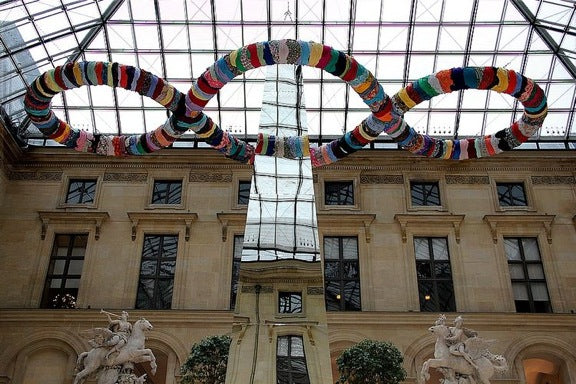
It all begins with a strange symbol on Pei's glass pyramid: the modified infinity sign. It is the entrance to the exhibition of Michelangelo Pistoletto, an Italian Arte Povera artist, at the Louvre Museum. Not many works, but the main ones, those that marked his success and allowed him to achieve worldwide recognition, making him a pillar of this artistic movement that uses humble products (earth, wood, rope, burlap, worn clothing, etc.) and positions them as artistic elements in order to challenge the cultural industry and, more broadly, consumer society.
Scattered throughout the museum, from the ground floor to the underground levels, the artist's works trace what his research was over the years. From early representative examples of Arte Povera, such as the famous Venere degli Stracci, to the
Thus, Venus, an iconic symbol of classical art and beauty, turns her back on the public and mingles with a pile of clothes, thus becoming the image of the senseless accumulation typical of consumer society.
The exhibition ends and is summarized in a new infinity symbol: the third Paradise, created by Pistoletto himself, an expression of a fusion between the first and the second paradise. The first being a paradise where human beings were fully integrated into nature, and the second, an artificial paradise, developed by human intelligence through a process that has now reached the proportions of globalization.
See you in paradise!
www.louvre.fr
April 24 - September 2, 2013 "Year of Le paradis sur terre", Louvre Museum, Métro Palais Royal / Musée du Louvre.


Text: Elena Bormida